July 2016
You see with your ears
June 2016
Prosopagnosia — Face blindness
May 2016
The digital human
Fourth industrial revolution
Flipped learning
April 2016
Knowledge Management System
Education goal
February 2016
Brain
Neuroplasticity
Genetics
Memory
Slow Learning
Boredom
Anthropology and education
Random knowledge
Knowledge for a purpose
Knowledge management
Visualisation
Netiquette
To taste and to know
December 2015
E D Hirsch jn.
Core Knowledge Foundation
Unleashing the power of knowledge
August 2015
New Goal
My Credentials and Philosophy
Original article 2001
April 2015
1. Gutenberg
2. Caxton
3. Teaching
Comments on our education system
New league tables
Qualified teachers
4. Too much knowledge
Random knowledge
Knowledge management
Knowledge tree management system
Future Shock by Alvin Toffler 1970
5. Dumb terminals, cloud & data entry
Integrated fibre optics
Keyboard
Speech recognition
6. Spatial awareness
Photography
Handwriting
Cultural literacy by E D Hirsch jn.
Critical importance of early schooling
Rise of fragmented curriculum
21st Century Education in the Post Caxton Digital Era
Report Sept 2014 — Sept 2016
The report is a rewrite of material written in my Blogs below. It removes duplication, clarifys and adds material.
Student Loan Contract Unenforceable
Press Releases
This is an educational Blog written in diary form in reverse chronicle order.
It is my personal point of view of education in this digital age.
Early in my research I established three main themes:
Lack of an educational goal: Power is the application of knowledge: Knowledge is random.
Later on I started look at how the surfit of knowledge could be controlled.
The contents page has been included as I kept adding topics which appear to be random.
The diary entry may be in a short form but expanded in previous related ideas.
Use the external links to expand the content.
Contents
Please contact Editor if permission has not been obtained.
Please feel free to use any of my material
July 2016
You see with your ears
The use and power of sound is not a sense our educationalist have much interest in.
Listening is not just about the words but all the other things that sounds add to the richness of our daily lives. They positively or negatively change the brain’s memory and our experiences.
Turn off the sound to a TV programme or film and think how the lack of sound reduces the effectiveness of the silent images to convey meaning. In many cases it makes them unintelligible.
The film director gives context to the plot by adding music and background sounds to images, enhancing the experience and reducing distractions. Directors uses sound to make you look at what they want you to see.
They say “Radio is the theatre of the mind” but this requires the listener to hold the same visual images as the speaker otherwise the listener’s perception will be different to the speaker’s purpose. Is this intentional?
“Speech is Time: Silence is Eternity”.
“Speech is Silver: Silence is Golden”
“Speech (nature) abhors a vacuum”
Society appears to be frightened of silence as it is in such short supply. Everybody has to be in immediate contact to avoid being out of the loop.
Silence is powerful.
If you lost the plot when speaking, I was taught to stop and count to ten giving your brain the chance to catch up and feed oxygen to the brain. Your audience will not notice.
“we found that what we imagine hearing can change what we actually see, and what we imagine seeing can change what we actually hear.”
Imagination can change what we hear and see Karolinska Institutet June 27, 2013
“The brain can, if it must, directly use sound to see and light to hear”
Scientists say we can see sound
One science classroom I taught in was a narrow and long concrete tunnel with six rows of five students. A sound meter gave a reading over 95db. You can imagine it was impossible to teach as you could not be heard at the back and the sound level destroyed any form of discipline.
To its credit, the school did experiment in another classroom with surround sound system with speakers in each corner; the teacher used a neck microphone similar to those used for deaf students.
The difference in student attention was remarkable as the teacher was heard in silence. Very simple but when I came back to the school a year later the ceilings of the whole block had been fitted with false ceilings. Not nearly effective as all the other walls were still concrete.
Acoustics Interview with Professor Trevor Cox — BBC Radio Four. Life Scientific.
June 2016
Previous entries highlighted our educational establishment’s lack of understanding of how the brain works with basic failures to check if our children can see coloured still or moving images.
Here is another example.
Prosopagnosia - Face Blindness
This is a brain disorder effecting about 2 in 100 of the total population. It is the inability to recognise faces and can be genetic or caused by brain damage. Many families have this without recognising it by putting it down to a poor memory.
They get around the problem by recognising features such as colour of hair, size, appearance or voice.
Babies use smell, voice and touch.
It affects people remembering places and objects, to navigate and the ability to see angles and distances.
It has significant educational significance as it is a cause of shyness, social withdrawal, difficulty of making friends and recognising characters in still and moving images.
They will have difficult in recognising their teacher and this may appear as disobedience. Close friends may not be recognised and this may appear to be rude causing friction.
These children are at the risk of walking off with strangers.
Related to Autism, ASD or Asperger?
Face blindness - when you can’t recognise a familiar face
Impact of Prosopagnosia
May 2016
The Digital Human
This is an area I have not looked at before and it is relevant to us all in the “Post Caxton Digital Era” Automation of our lives is changing rapidly whether we like it or not.
Computer programmers are removing the human element in repetitive tasks using “Artificial Intelligence” to control the processing.
Any task controlled by humans is referred to as “Artificial - Artificial Intelligence”. Another term used is “Human Janitors” who carry out small restricted tasks that computer cannot handle or are too expensive.
Goods in Amazon’s huge warehouses are picked from storage by robots and sent to distribution where “Human Janitors” pack the products. Even this is being automated, hence the large box for a small object.
“Microwork” is another term being used referring to limited tasks that are completed remotely over the internet for a small payment.
“Gig Platforms” are where buyers and sellers of services can find one another online. It provides an on-demand workforce with both parties dealing directly avoiding third party employment agencies.
Businesses can maximise flexibility and minimise costs by hiring the skills necessary to optimise the task as opposed to carrying expensive full time employees.
“Gig Economy” is investing in what you need when you need it.
Fourth Industrial Revolution
Watch this short clip by John Bremen, Human Capital & Benefits Leader, North America, for Willis Towers Watson, as he describes the Fourth Industrial Revolution, or the “Uberisation” of the workforce.
Our society is in denial over the effects of this serious problem with the rapid decline in a stable permanent workforce with the reduction in job prospects and progress, flexible hours and reduced benefits. One form is the “Zero Hour Contract” covering all level of skills not just for the low paid. In the USA, the middle class are beginning to feel the effects.
What has this to do with education? Everything, the use of knowledge is now all around you in the disguise of “Apps” which are no more than computer applications designed to perform simple repetitive tasks. Much of Maths is redundant with the end user becoming the Human Janitor.
One of the themes of this report is “Power is the use of knowledge” and this is exactly what you are doing. You don’t need to know how the “Artificial Intelligence” process works but the relevance of its inputs and outputs.
I wrote my first App over ten years ago as part of a website.
This based on the “Digital Human” by Aleks Krotoski BBC Radio Four “Work”
Flipped Learning
In a standard academic classroom the teacher goes through the knowledge to be learnt then the student shows that they understand and can use that knowledge by examples.
With homework set for reinforcement.
Flipped classroom is where the students learns the subject knowledge at home via the internet and then use it in the classroom to perform tasks to verify that they understand and know how to use it.
Flipped learning is completely different as it makes learning the responsibility of the student with the teacher in the role of a tutor motivating individual learning by providing specific knowledge, skills and facilities.
F - Flexible Environment
Students choose where and when to learn, in groups or individually.
L - Learning Culture
Learner-centred with in-class time used to expand topic.
I - Intentional Content
Course content tailored to suit student’s needs.
P - Professional Educator
Teacher motivates and monitors learning in the background.
Source:
The four pillars of FLIP and Review of Flipped Learning from Flipped Learning.org
Flipped learning is an interesting concept but fails to address basic requirements in this digital age and is limited by the lack of qualified teachers.
It still relies on schools/establishment to control what, where, when and how learning takes place with exams determining effectiveness.
Still requires specially trained teachers who in short supply and non existent in some countries.
Limited controlled subjects with content supplied by companies. ie not free.
Requires motivated students. Physically no different to existing schooling.
April 2016
This research report explores how digital media is already effecting education worldwide and shows up the widening gulf between words and images.
The brief came from an opinion I wrote in my Design Technology website in 2001 but not expanded until I had time on my hands in September 2014.
The initial brief was broken down into nine sections shown by the links above which appear at the end of this report.
There are two significant points to note being the Student - University and Student - Loan contracts which, in my opinion, have serious problems with contract law. They should also be considered as a combination of the PPI and Sub-prime mortgage scandals.
Between April and July 2015 I stopped to see if the UK general election would changed anything.
Three more sections were added August, December 2015 and February 2016.
One of the major themes running through this research is “Random Knowledge” which I first became aware of when writing my DT website. It took over two hundred internet searches to find one good one and only found ten in the end.
I setup my own search engine to save me time keep going back these ten sites for information.
One conclusion from my report has lead me to setup a website to manage the educational knowledge necessary for education in the digital age. “Education Knowledge Management System”. June 2016.
In the digital age of readily accessible knowledge, the phrase “Knowledge is Power” is now being superseded by “the use of Knowledge is Power”. This report is an example.
Education is Free on Demand for any
Age, Ability, Subject, Place, Time and Media
One of the things I have learnt during my years in engineering, industrial design, sales and marketing is to identify problems by keep removing elements until the thing stop working.
Education is no different from any business as it has an input, process and output. It’s questionable if they are still a not-for-profit business or becoming privatised via the back door (Academies)?
The new Academies building look like state of the art office blocks and their longevity is questionable as digital education will make their current purpose irrelevant. Buildings have little influence on education as does class size.
Hard and software in schools are designed for teacher lead learning and government determined restricted academic subjects. Digital technology will allow for personal learning.
The system of dividing learners into age defined classes defies the known logic that all learners are unique having different intellectual and dexterous skills. For the majority, intelligence is dependant on their genes with some environmental influences.
Subjects taught have little relevance for today’s needs let alone the future. Society is not deciding what subjects are learnt as our politicians leave this to an unelected and unaccountable civil servants.
The continual changes made to subjects, their structure and management is a very good indication showing that our educational leaders do not the slightest idea of what they are doing. They have no goal. Do you think Ms N Morgan could have come up with the new Progress 8 League Tables? By now any business would have failed.
From my experience teaching maths, 75% of what is taught is irrelevant to 75% of our learners. Spread the middle school (y1 - y6) syllabus over the whole period up to the end of school (y11). Less is more.
The CBI (Confederation of British Industry) is always moaning that students lack math’s skills but they have never stated exactly what skills are needed.
Khan Academy in the US is a free website teaching maths online without the need of teachers.
Our education politicians are thrilled by their power of “Command and Control” testing anything that moves. This is a historical throwback to when the state used schools to indoctrinate and control the serfs, peasants and workers.
One source likens schools to prisons as it’s a criminal act not to go to school where you are forced to do what you are told.
This is a bit harsh but certainly schools are a giant crèche giving children below 16 something to do from 8am to 4pm while their parents are working. Teachers are the only parents who don’t have to find alternative child care during school holidays.
Digital education will give learners the freedom to control what and how they learn.
Finland’s education bears little resemblance to ours. Very young children are being trained to taste food, apparently reducing obesity. What do they know that we don’t?
February 2016
This article was started a year ago to explore how technology is changing our education from my view point as a design engineer and latterly a teacher.
My research has lead me to conclude that this digital age needs its own “mantra”
Education is Free on Demand for any
Age, Ability, Subject, Place, Time and Media
Technology has removed the restriction to access knowledge
Knowledge to be used for a purpose and managed
Learning must harness the power of the brain
Knowledge found randomly is valuable
All senses to be used together
Age and ability irrelevant
Free on demand
All subjects
All media
The Brain
Neuroplasticity
Our existing education system is at odds with the current understanding of Neuroplasticity which is vital as it determines how we learn.
Genetics
“The models suggest that in impoverished families, 60% of the variance in IQ is accounted for by the shared environment and the contribution of genes is close to zero. In affluent families, the result is almost exactly the reverse.”
Memory
When information passes from the short to long term memory it discards anything that is unimportant or does not understand. It checks and replaces existing long term memories or creates new memory areas. Exams are nothing more than a test of memory.
Slow Learning
The speed of learning is enforced by the curriculum and not by the ability to learn. If you don’t understand the first part, the rest will be ignored which leads to boredom.
(This is nothing to do with slow learners.)
Boredom
This is a serious matter of concern as our brains need to be stimulated to keep the brain cells growing and not die. We ignore it at our peril.
Boredom is a direct consequence of the rigid education system.
Educators must understand how the brain works
<more>
Anthropology and Education
Education is a fundamental influencer of our society and Anthropologists study this change in stages from hunter-gatherers, primitive agriculture, feudal obedience, religious indoctrination and to our current factory style education.
A Brief History of Education. From Professor Peter Gray’s “Free to Learn”.
Anthropology is a study of humanity looking at how we are different and alike. “Everybody is unique”.
His book covers a wide range of topics from “Seven sins of our system of forced education”. (p66) to the “Reasons for the decline in trustful parenting”. (p212).
“Video games give children total freedom without the interference from adults. It allows them to explore.” (p67). This is a reason why Khan Academy’s online maths is so successful. No teacher.
<more>
Random Knowledge
This article was constructed from knowledge sourced from random experiences beyond my control. I have always accepted this and used it to my advantage in my designs.
Teacher Training introduced me to Gestalt psychology. “The whole is greater than the summation of the parts”. The creative ability is to choose which piece of random knowledge to keep and which to discard.
Technology over the last ten years has opened up the opportunity to learn without the need of teachers and importantly, outside the control of the education establishment.
Random Knowledge has to be valued and managed
<more>
Knowledge for a purpose
My first view on education was that it was elitist. It’s much more sinister than that. I struggled to find a way explain what is actually taking place until I came across the Ancient
Greeks splitting knowledge into two types “Episteme and Techne”
Knowledge for the sake of knowledge and knowledge for a purpose.
Knowledge for knowledge sake is the backbone of our education system as it can be compartmentalised and controlled. This was the power of the Academics as they dolled out what they wanted and when.
Contrast this with today’s learners as they will immediately Google the answer. Power has now shifted to those who use knowledge to solve a problem. Like the engineers.
Technology has removed the restriction to access knowledge
<more>
Knowledge Management
Search engines, such as Google, are grossly inefficient in searching knowledge as the results are random and unreliable. Wikipedia is better but both are not designed for sequential learning. In 2008 I constructed a specialised search engine for Design Technology searching only the best 10 authoritative websites.
One golden rule in design is “Do not reinvent the wheel” -- change other’s ideas.
Much time and money has been spent on the national curriculum setting out what has to be learnt so it makes sense to use this to help to start populating the “Knowledge Management System”.
This does not contradict my belief in “Knowledge for a Purpose” as we have to start somewhere that is known to teachers and students and will benefit them without creating additional work. It digitises textbooks making them freely available anytime.
This is not a search engine and will have no external links as they disappear and not controllable. Schools will be secure as there are no avenues to escape to distraction or be hacked. Governments, ISP etc can offer this service free as it will not be a gateway out.
Simple “Factlets” built up step by step into a “Knowledge Tree” so a learner can access it anywhere depending on their prior knowledge. It is knowledge for knowledge sake with no attempt to teach.
Management of knowledge has to be strictly controlled at the beginning of the learning process but it will be the learner’s choice when to get off. The tree will naturally have branches to allow the learner to explore into other areas which can grow organically.
Knowledge tree
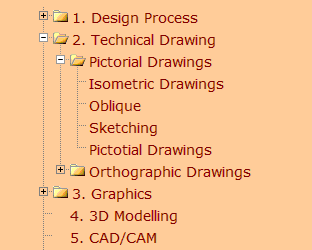
Education Knowledge Management System website shows two basic structures, the familiar Logic Tree shown above for Technology, Food and Maths. Science topics are arranged by Subject, year and topic. I have added content to The Technology tree from my own website to show how it will work.
Once the system becomes stable online learning material will be added but its software construction must be considered right from the start.
<more>
Visualisation
There is a fundamental flaw in UK’s education as it doggedly clings on to the written word when we are surrounded by visual, aural and oral stimulation from YouTube, Skype etc..
The ability to take pictures is now there for most on their phones but we do not teach the skill of taking still and video pictures. Oh, I forgot, it’s not academic.
The government has stopped testing children for colour blindness. 1 in 12 boys and 1 in 200 girls have some problem with 25% severely. That’s at least 1 in a class of 30. Online tests are available. There are 3 million colour blind people in the UK with 45,000 children.
70% in Y7 (11 years old) are undiagnosed.
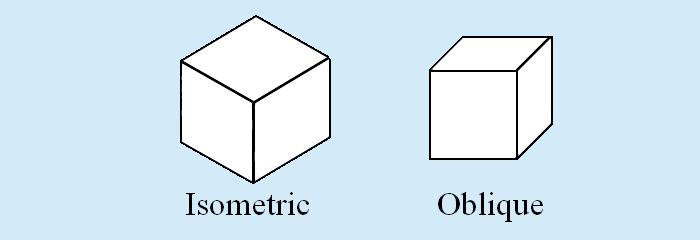
From my un-scientific test of drawing an isometric cube on the board and asking pupils to copy it, I found that 50% of our population are visually illiterate as they draw the cube as a different shape (oblique) learnt in primary school. Worryingly, they see no difference.
Increase the spoken word, motor skill and spatial awareness at the expense of writing.
<more>
Netiquette
The internet is changing our society’s values and our schools should be at the forefront of understanding and promoting cultural standards.
The internet must not be allowed to eradicate one of human s requirements of face to face communications with all the implications of body language.
The mobile phone now appears to be physically attached to the body, looked at every minute to see if anything is happening. Friends texting each other even when sitting together. Children shouting at each other instead of talking. Rude.
Schools have a duty of care for its pupils on how they interact in this digital age.
<more>
To Taste and to Know (Sapare Movement)
5% of our DNA Genome is made up of olfactory receptor cells that identify odour molecules. Humans can detect 10,000 separate smells and many more combinations.
We identify a particular taste by memorising the combination of chemical odours. We know this as we taste our food with our nose and loose the majority of it when we have a cold.
Only sweetness and bitterness are hard wired in our brain and the rest of our taste memories have to be learnt.
Genes do not determine our choice of food.
The baby of a pregnant garlic eating woman will like garlic for the rest of its life unless the memory is unlearnt.
Since 2004, kindergarten children in Finland receive instructions in how to explore food ingredients with their senses. Their attitudes to eating were radically altered and with it the levels of obesity.
Eating is the forth fundamental requirement for life after air, water and light and it is a learnt process totally ignored by Educationalist.
From “First Bite; How we learnt to eat” by Bee Wilson. Reviewed by R Cooke, Guardian
What is it like not to smell? The neglected sense. by Kathy Clugston, BBC Radio Four
December 2015
This article was started in September 2014 and halted in April 2015 to see what would happen in the following month’s General Elections. Nothing but more doom and gloom. Tales of teachers just getting up and leaving with no job to go to. Grants now turned to debits (loans), no mention of debits rising due to compound interest. I stopped reading education articles as it was so depressing.
I did no restart again to complete as there was something lacking. One of my themes is the “Randomness of Knowledge” and by chance, I came across an interview with E.D Hirsch, Jr in the TES 6th November on a staffroom table.
This lead to Hirsch’s lecture, his book “Cultural literacy”, Michael Young’s “Unleashing the power of knowledge for all”, and then finally to BBC’s “The School of Hard Facts” which posed the question as to why Scottish education is not following England’s ideology.
E.D. Hirsch, Jr’s book “Cultural Literacy” written in 1988 was the subject of the 2nd Annual Policy Exchange Lecture given in September 2015 which was introduced by our very own Minister of State for Schools, Nick Gibb MP, who opened the lecture with:
Over the last five years his ideas (Hirsch) have transformed the education debate in this country and had a significant impact on government reform.
Reading Hirsch’s work I had the strange sensation that he had taken my own incoherent and disparate thoughts on education and turned them into an articulate and intellectually robust case for action.
In the first meeting of civil servants after the 2010 Election to discuss the curriculum review, all the officials came into the office with bound copies of the core knowledge curriculum and in this way Hirsch’s work in America provided us with a tangible precedent for our thinking on the English National Curriculum which could reassure civil servants that we were not entirely alone in our ideas.
By this time the book was 22 years old and education is well into the digital age and not just words on a page.
In the interview with Jon Severs in the TES 6 November 2015 Hirsch says “Even today I am still being misinterpreted”.
To see what all the fuss was about I bought a copy of “Cultural Literacy” (14hr from Amazon) and saw little of Gibb’s “Tradition” “Core” prescriptive education.
Like the good lawyer he was, he took the parts he wanted to hear and ignored the rest.
Current thinking is “intelligence is 50% genetic and 20% nature.” says Professor Plomin. BBC Radio 4, Life Scientific. Another random find.
Core Knowledge Foundation was set up by E.D.Hirsch, Jr in 1989 and in 2010 a UK version was set up by Civitas, a right leaning education charity. It is an English translation of E D Hirsch’s Guide for Schools.
“Key facts a child should know at primary school”.
True to Hirsch’s writings, their “Cultural Literacy” knowledge/skills are designed solely for primary children as opposed to Gibb and others implementing it in secondary schools.
“Core Knowledge” is carefully sequence for year groups in Language and literature, maths, history and geography, science, music and visual arts. The content harks back to past centuries.
Should “Educators and Academics” have the monopoly of choosing what should and should not be learnt?
I came across Michael Young’s “Unleashing the power of knowledge for all”
In contrast to the idea of the curriculum as ‘knowledge of the powerful’, the idea of ‘powerful knowledge’ refers to what makes some knowledge powerful and what it can do for those who have access to it. Knowledge is ‘powerful’ if it predicts, if it explains, if it enables people to envisage alternatives, if it helps people to think in new ways. If these are some of the ‘powers’ of powerful knowledge, how might it then be distinguished from the everyday or commonsense knowledge that we all have as members of society?
It is interesting to compare Michael’s “Knowledge of the powerful” and “Powerful knowledge” with my “Knowledge for knowledge sake” v “Knowledge for a purposed” explained in my “Two types of knowledge” section.
Gibb (law), Gove (journalist) and, by association, Morgan (law) are using E.D. Hirsch, Jr’s book to give credence to their beliefs that today’s education should mirror their privileged narrow elitist academic upbringing. They have taken what served their purpose and ignored conflicting arguments.
I feel very very sorry for them as their cherished beliefs in 19th century education values are irrelevant in today’s digital world.
Their power of “Command and Control” is being usurped by outside influences. The “Khan Academy” is showing education can be provided by others beyond government’s control.
The UK desperately needs “doers” not “thinkers”. Designers and manufactures use to be the backbone of this country.
Please contact if permission has not been obtained. Editor
August 2015
The outline of this article was written in 2001 & 2005 for a Design Technology website.
My research restarted in December 2014, first looking at Caxton’s influence in the mid 1470’s on the English we know today. He printed his first book in England in English in 1476.
None of this would have happened if it was not for Gutenberg’s prior invention of the mass production of printing in the 1440’s. His achievement in manufacturing type pieces to a consistently high degree of accuracy has been ignored by historians. It had the same social and technical impact as Henry Ford’s Model T car in 1908.
My experience is in engineering, product design, marketing and sales. For the last twenty years I have been teaching on year long contracts and, latterly, short term and day work. This allowed me to teach in every type of school, subject and age.
So I am a designer who happens to teach and not the other way round.
This is important as I see education from a totally different perspective looking for the needs and desires of the learner and not the system.
One of the themes of this article is the use of knowledge, its purpose and status.
The Ancient Greeks (Aristotle) recognised that there were two types of knowledge
Episteme = Knowledge for Knowledge sake = High status
Technie = Knowledge for a Purpose = Low status
Knowledge has been closely guarded for hundreds of years by a small elite as it is their means of power. The knowledge is handed out when, where and how at their convenience. It is fundamentally undemocratic, restrictive and insular.
The difference between the two types of education is highlighted in BBC Radio Four "Any Questions" and "Any Answers" 8 August 2015 as promoted by Toby Young and Anthony Seldon
In today’s digital world “Use of knowledge is the power” and not the knowledge itself.
“ The illiterate of the future will not be the person who cannot read. It will be the person who does not know how to learn.
Tomorrow’s schools must therefore teach not merely data, but ways to manipulate it. Students must learn how to discard old ideas, how and when to replace them.
They must, in short, learn how to learn. ” “Future Shock” by Alvin Toffler 1971
Parents at parent’s evenings brought home to me how low the status of Design Technology really was, “my son will not being choosing Technology for his GCSE as it is not an academic subject”. The head of one school said that we do not need Technology as can all be covered by Art and Science.
“We tell children to go to school because it will be useful to them in the future. This presupposes we know what the future will be like ... Most educators, like most political leaders, think the future will simply be an extension of the present. Nothing could be more dangerously mistaken. ”
“Future Shock” 1971
Another theme is the abundance of knowledge, its randomness, quality, looseness and obsolescence. Knowledge Management is now an academic and business subject showing up the importance of structuring knowledge so it can be used efficiently.
How knowledge is being managed is a cause of the collapse of our education system.
This was forecasted in “Future Shock” 1971
“It would be a mistake to assume that the present day education system is unchanging, on the contrary, it is undergoing rapid change, but much of the change is no more than an attempt to refine the existing, making it evermore efficient in the pursuit of ‘obsolete goals’.”
During my research, I kept finding media articles about education and printed them off highlighting relevant parts. The pile started to grow and organically evolved into its own system of 20 sections. A list of links to all articles can be found at “Link” and I stopped collecting when it reached 350+. The last one was “ GCSE results are down to your GENES”. Say no more!
The outcome of collecting this pile has not been very productive as the majority are negative showing gloom and despondency at the collapse of our educational system.
Khan Academy, a free online school supported by the Gates Foundation shows a possible solution.
This asks the question
What is our goal for the 21st century digital era?
The new digital system needs its own “mantra”
Education is Free on Demand for any
Age, Ability, Subject, Place, Time, and Media
It must recognise that
- Everybody is different, learn at different rates and have different needs and abilities.
- Access to learning must take into account physical difficulties due to ability, location, time and media.
- Teach people “how to learn” how to use knowledge for a purpose and not an academic exercise in gaining knowledge for knowledge sake. Knowledge does not infer status or hierarchy.
- Power comes from the ability to use knowledge for a purpose and recognise that knowledge can become obsolete. The creative ability is in finding, choosing or rejecting knowledge.
- Knowledge Management needs to be structured to operate in a “Plug ’n‘ Learn” environment, constrained by the sheer abundances of knowledge and not confined to specific subjects.
- Our present system is undemocratic and elitist creating haves and have nots.
- There is too much knowledge so it has to be restricted and structured to be learnt.
- No subject takes precedence over another and has a higher status.
- The digital world must not focus on the display screen to the exclusion of all else. Our bodies are designed to see, hear, speak, feel, move and use all senses.
- Practical skills to be taught for society’s benefit and not as academic subjects.
- The learner should take control of their own education. It is not for the system to say what has to be learnt and in what order.
- Recognise that efficient learning need not take place in a school or university.
- We all learn at different rates and age is never a factor. The system must not disadvantage the sick and summer born.
- Failure is a valuable learning tool as it can be identified whereas success is difficult to see. Learn through experience.
- Mentoring is necessary as well as Peer to Peer learning.
- Competence is measured by what you achieve and not by fixed examinations which only measure your ability to remember.
- All data and its application held on one source accessed by simple devices.
- All data to be held internally within the system to avoid the danger or loss of uncontrolled external sources. To have its own search engine.
- Digital information distribution effects how individual and groups will affect society in ways we have not thought about. Some good and some bad. Remember that computers are dumb and it is us humans that screw up.
- Must be introduced over a long time and benefit teachers as well as learners.
This is the Post Caxton Digital Era
My credentials
35 years in Industry
Mechanical engineer/designer, Industrial Designer — Products, Marketing and Sales.
Awarded membership of Society of Industrial Artists and Designers.
Design Technology website 2001. Educational search engine 2008.
Inventor of the Sweetex Handheld Tablet Dispenser.
10 years Teaching
Long term contracts from 2 to 5 terms teaching Design Technology — resistant materials, graphics, textiles, electronics, science, ICT, GNVQ/BETEC engineering and marketing.
11 years Teaching
Short term contract and day supply work teaching Design Technology, science, maths and special needs.
School types
Primary, secondary, academies, grammar’s, sixth form, religious, public, special needs. Male/female/mixed.
As an Industrial Designer I am an archetypal “Techne” believing that “Knowledge is there for a purpose”.
My philosophy
“The whole is other than the summation of the parts” Gestalt 1890.
By “other” I mean that the whole can be unrecognisable from its parts.
Having written most of this article I came across my original written in 2001 for my Design Technology website. It was surreal to read something and sudenly realise you had written it, my subconsciously must have guided my thoughts.
I started with Caxton and Gutenberg but research kept leading me off in odd directions which resulted in the nine research topics.
I spent hours listening to Radio 4’s 2005 Reith Lectures on the Triumph of Technology and eight programmes called The Educator. It was gratifying to see that others are thinking along the same lines.
My original article was published 23 October 2001
It is interesting to see how the original idea is still valid and technology now makes it possible.
We are now in the “Post Caxton” Era
“Caxton era” is the world of print and fixed images.Information is stored on paper in the form of printed words or static images normally in black and white and accessible to a few through books.
The world of the Academics is based on the exclusivity of printed knowledge.
When Academic knowledge is available to all, then the reason for existence of Academics all but disappears.
“Post Caxton era” is the world of Sight and Sound and moving images.
Information can be stored digitally in the form of words, speech, fixed or moving images in colour and be accessible from anywhere, by anyone, at any time.
Computers are now powerful enough to run voice activated programs. The physical action of using a keyboard to input information in the form of words will soon be a thing of the past.
The written and printed word will still be important as a means of transmitting information, but the importance of the printed word on paper in the form of books will be reduced.
Teachers have a common body of knowledge that could be stored on one or two CD’s and be accessible to all including the pupils.
The role of the teacher will not be as a font of all knowledge but as a facilitator.
Today's children are in the “Post Caxton era” receiving information in the form of a continual stream of coloured images and sounds; But at school they are being subjected to an educational regime founded in the past. No wonder they have little motivation and poor discipline.
All 12 educational opinions from October 2001 — February 2005 are available,