4. Too Much Knowledge
It has been estimated that there were around 30,000 books in circulation before Gutenberg’s printing press in 1440.
50 years later, there were over 10 million books.
The problem today is that there is too much knowledge which is only found by random searching and much is of dubious quality and easily lost if not recorded.
This randomness does have its positive side as it accidentally puts data together in unexpected ways that you would never have thought of.
The clever thing is to be able to recognise if this combination is of value or not.
“One problem in the area of education, and others, was the paradoxical impermanence of much digital data. There was a tendency to ‘lossiness’ around the web, and ‘link-rot’, where material which had been available via links in academic articles was simply no longer there after a while, was an increasingly well-known and worrying phenomenon.”
From the Ditchley Foundation
Managing the digital revolution: can governments keep up. 20 - 21 March 2014
“The last century has given us so much knowledge and skills that it is beyond the capabilities of today’s people to hold in their heads and deliver.”
Lord Broes. 2005 Reith Lectures, The Triumph of Technology.
Sources
The Triumph of Technology, 2005 Reith Lectures
Random Knowledge
In 2001 I started to develop a website for Design and Technology and one of its features was to have carefully selected links to other relevant websites.
To do this I had to search 200 to find one good website.
This article was constructed from knowledge sourced from random experiences beyond my control. I have always accepted this and used it to my advantage in my designs.
Teacher Training introduced me to Gestalt psychology “The whole is greater than the summation of the parts” The creative ability is to choose what to keep and what to discard.
Technology over the last ten years has opened up the opportunity to learn without the need of teachers and importantly, outside the control of the education establishment.
Random Knowledge has to be valued and managed
Knowledge Management
Knowledge Management is a way of removing the randomness out of searching the internet.
Knowledge Management System places knowledge in a controlled structure with only one high quality piece of data. There is no attempt to teach, it’s pure “knowledge for knowledge sake” with no examples, tutorials etc.
There are no external links as:
Random searching defeats the object.
Links have a habit of disappearing.
Stops it being used as a conduit to external sites so it’s safe for schools.
Allows governments, internet providers and mobile phone operators to provide free access.
This idea comes from writing a specialised education search engine in 2008.
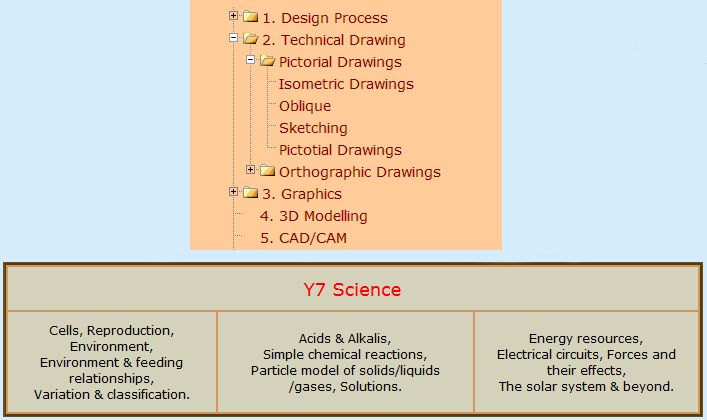
Knowledge tree
Science used the national curriculum structure of year groups and associated topics. This suits school’s timetabling but not children’s ability. The each topic is disjointed and inefficiently taught over years and have little relevance for a recognised relevant purpose.
Each topic searched three teacher selected websites.
The tree structure for technology came from my engineering experience. I looked back what I had learnt and taught and created general themes which could hold more specific information.
The technology section of my education search engine was constructed so that only the specific data could be searched reducing the number of hits. (wood - no, oak - yes). Technology only searched the best ten worldwide websites. (all in the UK). This combination reduced searching down to a manageable number.
The tree structure fits the “Mantra”
The Knowledge Tree takes a very wide look at the subject matter as a whole without curriculum constraints. It allows the system to expand in any direction. Subjects can be added on demand such as gardening and industry specific requirements. It will give pupils a wide range of subjects available at Universities allowing them to make a better choice.
Our politicians and civil servants have no understanding of what knowledge our society requires today and in the future. They think how they were taught is good enough. It begs the question as to who should decide what should be learnt.
The “Progress 8” league tables is the new revolution in managing our educational knowledge in doing so they have marginalised UK’s renown creative subjects. A choice now has to be made between History and Geography.
Businesses that continually alter their systems eventually fail with their staff leaving and competition taking over. Education is no different. The Khan Academy is already offering free online education suitable for the UK funded by Bill Gates.
To bypass the problem that society will never be able to decide what should be learnt; create an education knowledge mangementsystem that allows for organic growth across all subjects.
Just when I thought I had finished writing the original article I came across photocopies of ‘Future Shock’ by accident. It was gratifying that many of his thoughts reinforced my own in this article.
Future Shock by Alvin Toffler 1970
Alvin Toffler coined the term ‘Future Shock’ 45 years ago where he explored society’s resistance to change and promoted his theory of adaptation. Our lifetime has seen more changes than in all the previous 800 generations with technology feeding upon itself.
Toffler also discussed the origins of ‘over choice’ where society suffers from too much knowledge and the rise of diversity. “When we combine the effects of decision stress with sensory and cognitive overload ... the response is outright denial .... specialisation .... reversion to previous successful adaptive routines”
(ed. Education is one of the few areas of society which has failed to adapt, desperately clinging on to the past system in denial of the future and focusing on fewer specialisations. Maths and English now account for four of the eight subjects examined for the new “Progress 8 league tables”)
Chapter 18. Education in the Future Tense
“The whole idea of assembling masses of students (raw materials) to be processed by teachers (workers) in a centrally located school (factory) was a stroke of Industrial genius .... The very organisation of knowledge into permanent disciplines was grounded in industrial assumptions. Children marched from place to place and sat in assigned stations. Bells rang to announce changes of time”
(ed. Students still clock in twice a day at Registration)
“It would be a mistake to assume that the present day education system is unchanging, on the contrary, it is undergoing rapid change, but much of the change is no more than an attempt to refine the existing, making it evermore efficient in the pursuit of ‘obsolete goals’.”
Yesterday’s curriculum today
“Instead of assuming that every subject taught today is taught for a reason, should begin from the reverse premise: nothing should be included in the required curriculum unless it can be strongly justified in terms of the future.”
“What it does mean is that the tens of million children today are forced to spend precious hours of their lives grinding away at material whose future utility is highly questionable. ... review groups must not, however, set out to design a single all purpose permanent curriculum, instead, they must invent a set of temporary curricula.
Anyone who thinks the present curriculum makes sense is invited to explain to an intelligent fourteen year old why algebra or french is essential to him. Adult’s answers are almost always evasive.
“While all students should not study the same course, imbibe the same facts, or store the same set of data, all students should be grounded in certain common skills needed for human communication and social integration.”
“Just as genetic diversity favours the survival of the species, educational diversity increases the odds for the survival of societies.”
“Super-industrial education must therefore make provision for life-long education on a plug in/plug out basis.”
Adaptation to the unknown requires that we are taught how to deal with diversity of the unfamiliar and how to use this new knowledge. This, in itself, presents problems as our brain has limited storage so some knowledge will have to be discarded but which?
Education must embrace change and use it creatively and accept that this can take place anywhere.
All the money now being spent on Academy’s physical buildings is being wasted and should have been spent on educational materials to the benefit of all teachers and students. These new buildings only reinforce Toffler’s comments about the industrialisation of education. What evidence is there that these buildings advance education?
We now have to educate people how to learn at the same time as what they learn but remembering knowledge becomes obsolete over time.
And then there are the Tofflerisms:
“Change is not merely necessary to life – it is life.”
“Technology feeds on itself. Technology makes more technology possible.”
“The illiterate of the future will not be the person who cannot read. It will be the person who does not know how to learn.”
“Change is the only constant.”
“Obsoledge”is knowledge that is obsolete – an increasing hazard as the pace of everything, including change itself – accelerates.
What Toffler got right or wrong — Greg Lindsay Fast Company
The Tofflers Stir Up “Cyberdust” With New Scenarios — Greg Lindsay Fast Company
Additionl sources
Future Shock by Alvin Toffler 1971 — Wikipedia

